


DE ‘KONINGIN VAN DE HYSTERIE’

Bijgewerkt op: 6 jun
(EN HOE ZIJ HAAR RUG RECHT HIELD)

Als er iemand een bewogen leven had, dan was het wel Marie ‘Blanche’ Wittmann (1859-1913). We kennen haar vooral als de hulpeloos achterover hangende vrouw in Une leçon clinique à La Salpêtrière, maar wie iets verder kijkt, ziet een buitengewoon veerkrachtige vrouw.
In Brouillet’s schilderij ‘Une leçon clinique à La Salpêtrière’ zien we een college van de arts Jean-Martin Charcot. Voor een publiek van 26 mannen demonstreert Charcot een aanval van hysterie. Of eigenlijk: Blanche demonstreert de aanval. Onder hypnose werd zij in hysterische toestand gebracht. Met ontblote schouders en gesloten ogen hangt zij hulpeloos achterover in de armen van de onderwijsassistent. Haar handen in een verkrampte houding. Dit tafereel was niet zeldzaam. In die tijd waren patiënten in het Parijse ziekenhuis La Salpêtrière wekelijks het subject van tentoonstellingen. Niet alleen studenten kwamen daarop af, Charcot vulde regelmatig zalen voor 400 mensen met onder andere wetenschappers, culturele en artistieke elite en politici.
Blanche Wittmann, ‘koningin van de hysterie’ trok het meeste publiek.
Blanche werd op haar achttiende opgenomen in La Salpêtrière voor epilepsie. Al vanaf haar kindertijd had ze last van aanvallen, maar eenmaal opgenomen in het ziekenhuis begonnen die de specifieke, door Charcot gedefinieerde stadia van hysterie te volgen. Nog geen week na haar opname had ze haar eerste hysterie-aanval. De diagnose hysterie werd bijna exclusief aan vrouwen toegekend. Behandelingen omvatten elektrotherapie, het inhaleren van ether (tegenwoordig vooral gebruikt voor het oplossen van lijmresten) en het dragen van de ‘eierstok-compressor’. Een metalen gordel waarmee continue druk toegepast werd op de eierstokken.
De grootste focus lag niet bij het behandelen van hysterie, maar op het bestuderen ervan. Daarin was er veel aandacht voor de vrouwelijke geslachtsorganen. In het medische logboek van Blanche staan meerdere notities over onder andere haar menstruatie, het type uitscheiding dat ze die dag had, en de vochtigheid van haar vagina en vulva. Daarnaast waren de specifieke fasen van een aanval een onderwerp van studie. Charcot liet patiënten onder hypnose brengen om vervolgens een kunstmatige hysterische aanval te triggeren. Een hysterische aanval kende volgens Charcot vier fasen, maar de meeste patiënten weken hier zo nu en dan iets van af. Behalve Blanche. Blanche Wittmann was de perfecte hysterie-patiënt. Elke keer begonnen haar aanvallen met verkrampingen, gevolgd door acrobatische en onnatuurlijke houdingen zoals de naar achter gekromde rug, daarna het uitbeelden van emotionele en vaak seksuele scènes en als afsluiting hallucinaties en het uitstoten van onsamenhangende klanken. Het bracht haar een zekere status. Ze was ontzettend gewild voor de tentoonstellingen. Veel mensen kwamen speciaal kijken om een aanval van Blanche te zien.
Blanches ‘perfecte’ aanvallen, het startpunt van de aanvallen en het verdwijnen ervan na Charcot’s dood doen vermoeden dat zij meespeelde om maar in La Salpêtrière te kunnen blijven. Gezien de erbarmelijke omstandigheden is het lastig voor te stellen dat ze het ziekenhuis verkoos boven de buitenwereld. Honderden patiënten, veelal vrouwen, leefden in een gesloten omgeving waar een verschrikkelijke stank hing. De behandelmethoden waren wreed en patiënten werden gereduceerd tot objecten voor de medische wetenschap en voor vermaak.

En toch was het een bewuste stap van Blanche.
Het is tekenend voor de positie van vrouwen in die tijd dat veel vrouwen, waaronder Blanche, La Salpêtrière zagen als een toevluchtsoord. Blanche had sinds haar vroege jeugd te maken met fysiek geweld. Haar vader had regelmatig gewelddadige woede-uitbarstingen, waarbij hij Blanche zelfs een keer uit het raam heeft gegooid. Eenmaal vertrokken uit haar ouderlijk huis werd het niet beter. Ze kreeg meerdere malen te maken met seksueel misbruik door haar werkgevers. Blanche besloot dat een opname in La Salpêtrière de beste manier was om te ontsnappen aan deze omstandigheden. Ze ging werken als dienstmeisje in het ziekenhuis om zo een voet tussen de deur te krijgen. Dat lukte.
Na het overlijden van Charcot in 1893, stortte zijn theorie over hysterie ineen. Bijna al zijn trouwe volgers deden afstand van Charcot’s ideeën. De meeste patiënten werden genezen verklaard. Na 16 jaar als ‘koningin van de hysterie’, was Blanche plotseling vrij. Maar La Salpêtrière was toch haar thuis. Ze bleef verbonden aan het ziekenhuis, maar dan als technisch assistente op de fotografie-afdeling. Snel daarna kwam de radiologie op en stapte Blanche over naar een nieuw vakgebied. Radiologie was toen razend populair. De gevaren waren nog onbekend, dus iedereen kon continu foto’s van zijn skelet laten maken op kermissen en circussen en in speciale salons. Radiologen en assistenten werkten urenlang zonder bescherming. Voor Blanche betekende dat amputaties van haar armen en stralingsgerelateerde kanker die haar op 54-jarige leeftijd fataal werd.
Hoe hulpeloos Blanche er ook bij lijkt te hangen in Une leçon clinique à La Salpêtrière, uit haar verhaal blijkt vooral ook veel kracht. Ze maakte strategische keuzes om met sterk beperkte mogelijkheden nog een relatief goed leven te kunnen leiden. Ze liet zich opnemen om te kunnen ontsnappen uit een uitzichtloos leven. Eenmaal in La Salpêtrière was ze slim en creatief genoeg om een functie met enige status te verwerven. En toen de hype rond hysterie voorbij was, toonde ze veerkracht. Na al die jaren had ze nog steeds de energie om baanbrekend werk te verrichten op een nieuw terrein. Met alle gevolgen van dien. Iedereen die het verhaal van Blanche kent, ziet in Une leçon clinique à La Salpêtrière een vrouw die steeds weer opstond.
Bronnen:
Giménez-Roldán, S. (2017). Clinical history of Blanche Wittman and current knowledge of psychogenic non-epileptic seizures.
Diemar M. (2021). La Salpêtrière - Fact, fiction and speculation about Blanche Wittmann.

Romina de Lima is wetenschapsjournalist en schrijft voor HWP over historische vrouwen in de wetenschap. Ze is meestal druk met schrijven en onderzoeken, maar wordt ook enthousiast van lezen en bijenhouden.
- ENGLISH BELOW -
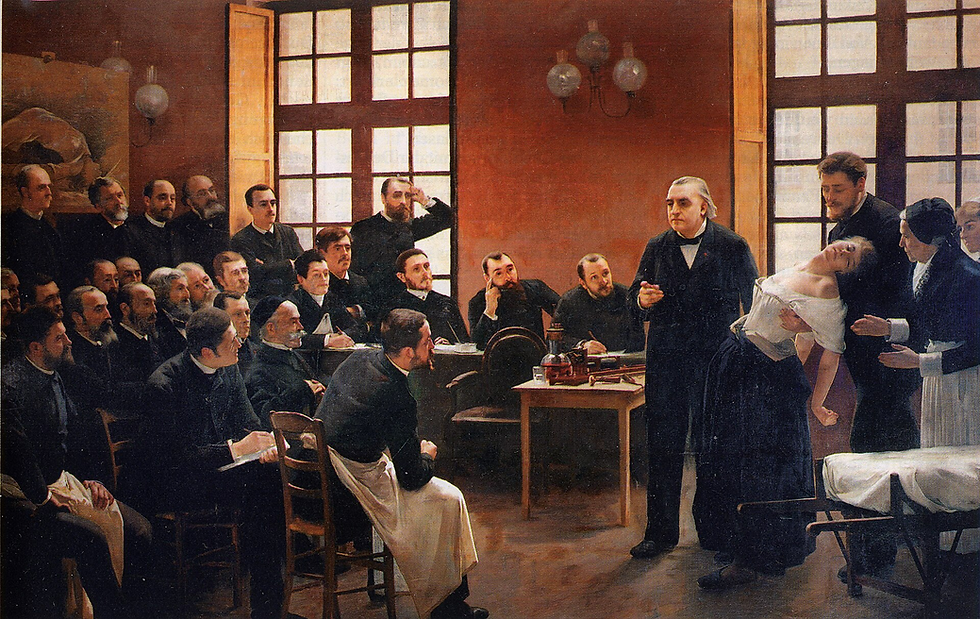
If anyone led an eventful life, it was Marie 'Blanche' Wittmann (1859–1913). We know her primarily as the woman hanging helplessly backwards in Une leçon clinique à La Salpêtrière, but anyone who looks a little closer sees an extraordinarily resilient woman.
In Brouillet's painting Une leçon clinique à La Salpêtrière, we see a lecture by the physician Jean-Martin Charcot. Before an audience of 26 men, Charcot demonstrates a hysterical attack. Or rather: Blanche demonstrates the attack. Under hypnosis, she was brought into a hysterical state. With bare shoulders and closed eyes, she hangs helplessly backwards in the arms of the teaching assistant. Her hands contorted. This scene was not uncommon. At the time, patients at the Parisian hospital La Salpêtrière were weekly subjects of public demonstrations. It wasn't only students who attended — Charcot regularly filled halls of 400 people with scientists, cultural and artistic elites, and politicians.
Blanche Wittmann, 'queen of hysteria', drew the largest crowds.
Blanche was admitted to La Salpêtrière at eighteen for epilepsy. She had suffered from attacks since childhood, but once admitted to the hospital, they began to follow the specific stages of hysteria as defined by Charcot. Less than a week after her admission, she had her first hysterical attack. The diagnosis of hysteria was assigned almost exclusively to women. Treatments included electrotherapy, the inhalation of ether (today used primarily for removing adhesive residue) and wearing the 'ovarian compressor' — a metal belt that applied continuous pressure to the ovaries.
The primary focus was not on treating hysteria, but on studying it. Considerable attention was paid to the female reproductive organs. Blanche's medical log contains multiple notes on, among other things, her menstruation, the type of discharge she had that day, and the moisture of her vagina and vulva. The specific phases of an attack were also a subject of study. Charcot had patients placed under hypnosis in order to trigger an artificial hysterical attack. According to Charcot, a hysterical attack had four phases, but most patients deviated from this occasionally. Except Blanche. Blanche Wittmann was the perfect hysteria patient. Every time, her attacks began with convulsions, followed by acrobatic and unnatural poses such as the arched-back position, then the enactment of emotional and often sexual scenes, and finally hallucinations and the uttering of incoherent sounds. It earned her a certain status. She was enormously sought-after for the demonstrations. Many people came specifically to watch one of Blanche's attacks.
Blanche's 'perfect' attacks, the timing of their onset, and their disappearance after Charcot's death suggest that she was playing along in order to remain at La Salpêtrière. Given the appalling conditions, it is difficult to imagine that she preferred the hospital to the outside world. Hundreds of patients, mostly women, lived in a closed environment that reeked terribly. The treatment methods were cruel, and patients were reduced to objects for medical science and entertainment.
And yet it was a deliberate choice on Blanche's part.
It speaks to the position of women at that time that many women, including Blanche, saw La Salpêtrière as a refuge. Blanche had experienced physical violence from early childhood. Her father had frequent violent outbursts, at one point even throwing Blanche out of a window. Once she left her parental home, things did not improve. She was sexually abused on multiple occasions by her employers. Blanche decided that admission to La Salpêtrière was the best way to escape these circumstances. She went to work as a maid at the hospital in order to get a foot in the door. It worked.
After Charcot's death in 1893, his theory of hysteria collapsed. Nearly all of his loyal followers distanced themselves from his ideas. Most patients were declared cured. After 16 years as 'queen of hysteria', Blanche was suddenly free. But La Salpêtrière was still her home. She remained connected to the hospital, this time as a technical assistant in the photography department. Soon after, radiology emerged and Blanche moved into this new field. Radiology was enormously popular at the time. The dangers were still unknown, so anyone could have regular photographs taken of their skeleton at fairs, circuses, and dedicated salons. Radiologists and assistants worked for hours without protection. For Blanche, this meant the amputation of both arms and radiation-related cancer that proved fatal at the age of 54.
However helpless Blanche appears to hang in Une leçon clinique à La Salpêtrière, her story is above all one of great strength. She made strategic choices to build a relatively good life with severely limited options. She had herself admitted to escape a hopeless existence. Once inside La Salpêtrière, she was clever and creative enough to secure a role with some degree of status. And when the hysteria bubble burst, she showed resilience. After all those years, she still had the energy to pioneer a new field. With all the consequences that entailed. Anyone who knows Blanches story sees, in Une leçon clinique à La Salpêtrière, a woman who kept getting back on her feet.
Sources:
Giménez-Roldán, S. (2017). Clinical history of Blanche Wittman and current knowledge of psychogenic non-epileptic seizures.
Diemar M. (2021). La Salpêtrière - Fact, fiction and speculation about Blanche Wittmann.
Romina de Lima is a scientific journalist and writes for HWP about historical women in science. She is usually busy writing and researching, but she also gets enthusiastic about reading and beekeeping.


Dit artikel is heel goed geschreven en leest prettig van begin tot eind. De tekst weet het onderwerp te behandelen zonder oppervlakkig te zijn. Ik heb de link naar een paar vrienden gestuurd die geïnteresseerd zijn in dit onderwerp. Het is een tekst die opvalt door de kwaliteit en helderheid van de informatie.